Context
Define the company, category, products, buyers, markets, and competitive frame.
Company brief
Ground every classification in the competitor's actual business.
The product
Competitor Radar follows the full research chain from public campaign capture to a decision-ready report. Every layer stays available for inspection.
Company, category, products, markets and buyers become shared context for every later classification.
Formats, copy, dates, markets, calls to action and destinations stay searchable and inspectable.
Ranked signals and cross-cuts expose concentration across message, format, market and funnel stage.
The report names the dominant play, supporting proof, weak spot and first move worth testing.
Missing labels, weak landing context and low-confidence classifications become visible before strategy is trusted.
Five connected modules
The output of each module becomes the context for the next. Strategy never has to start from a blank prompt.
Define the company, category, products, buyers, markets, and competitive frame.
Ground every classification in the competitor's actual business.
Collect public LinkedIn advertising records, creative, copy, active dates, markets, CTAs, and destinations.
Keep searchable records connected to their original artifacts.
Measure theme, persona, pain, proof, offer, CTA, landing-page intent, and funnel-stage distribution.
See where the visible campaign places its weight.
Synthesize repeated signals into the dominant play, funnel bias, proof system, weak spot, and response options.
Name the verdict, weak spot and first move to test.
Expose missing offer signals, insufficient evidence, weak landing-page context, and classification uncertainty.
Show what the report can support with confidence.
Campaign system view
Individual ads become useful when they resolve into a visible system of market, message, journey, proof and response.
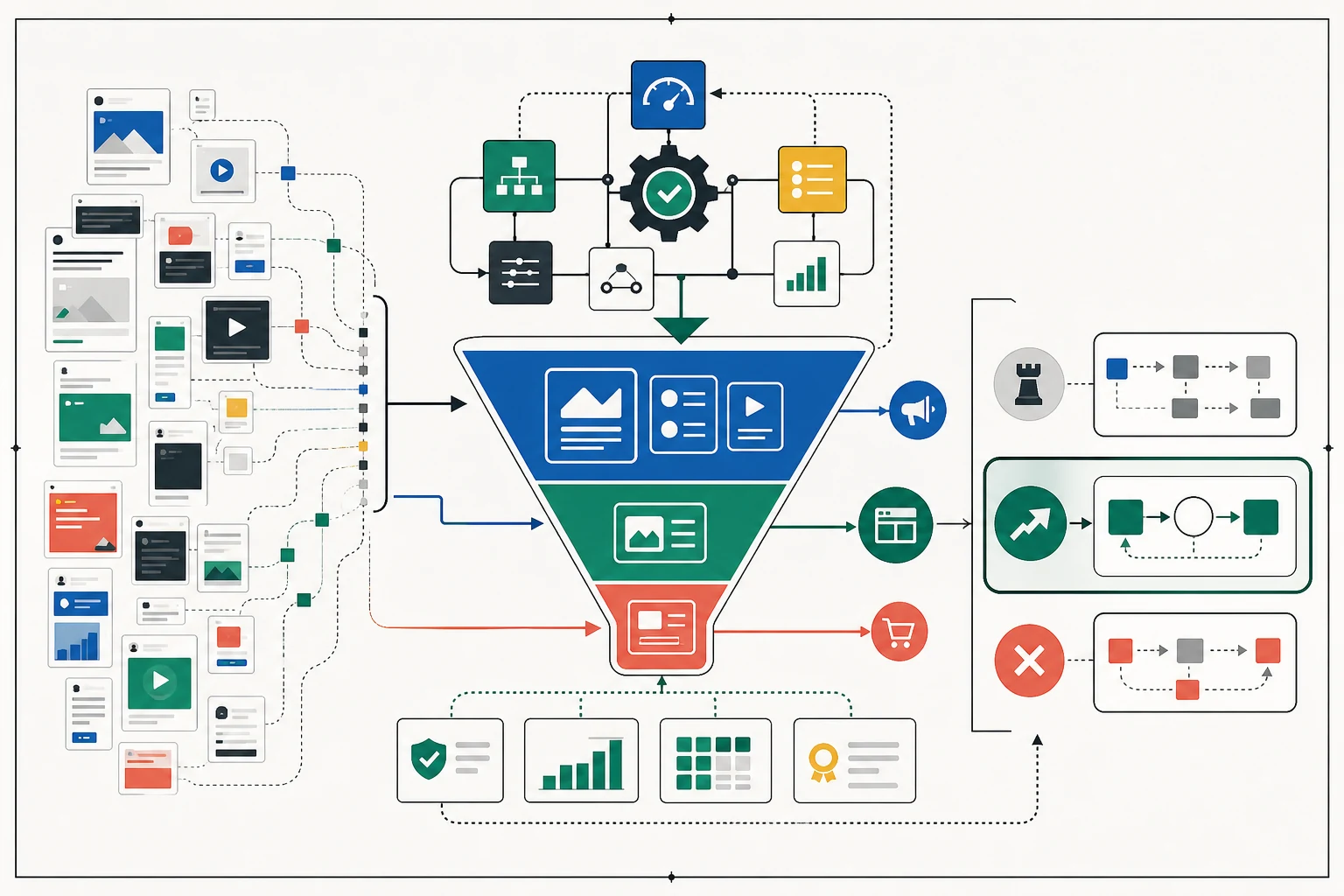
Shared campaign taxonomy
The taxonomy connects creative, market, message, funnel, and destination evidence without collapsing them into one generic AI summary.
Evidence contract
Public advertising can reveal campaign patterns. It cannot reveal private account economics or internal intent. The product keeps that boundary explicit.
Copy, creative, CTA, destination, page type, offer, market, and active dates.
Message hierarchy, funnel bias, proof strategy, dominant play, and response hypothesis.
Spend, ROAS, targeting settings, conversions, private tests, and internal decision logic.
Coverage architecture
Each platform retains its native campaign surface while feeding one competitor record.
LinkedIn private beta